|
1
|
- Perry Roland
- University of Virginia
- pdr4h@virginia.edu
- http://www.lib.virginia.edu/digital/resndev/mei/
|
|
2
|
- how it all started
- work on XML music markup begun (2000), originally named Music
Description Language (MDL)
- activities – ISMIR (2000, 2003), Int'l Conf. on Musical Applications
using XML (2002), MusicNetwork Notation Workshop (2003), OASIS Music
Notation Technical Committee (2003), Online Chopin Variorum Edition
meeting and white paper (2004)
- current version is 1.6 beta (2005), version 1.7 beta (2006)
|
|
3
|
- MEI covered in: Electronic Musician (2003), Experiencing Music
Technology (2004), XSLT 2.0 (2005)
- Regarding music markup schemes listed at coverpages.org:
- "[M]any of these initiatives will bear little fruit [;however,]
[t]here are at least two really serious contenders: the Music Encoding
Initiative (MEI) and the Standard Music Description Language
(SMDL). - Kay, p. 4
|
|
4
|
- encoding
- preservation of cultural heritage materials
- content-based searching
- analysis
- re-use
- interchange
- provide interoperability among a large number of representations
(current & future)
|
|
5
|
- audio / performance
- notation / written artefact
- selection depends on definition of "musical work"
|
|
6
|
- events are not discreet
- example: a note's pitch may change over time
- contains ambiguities
- homophones: C# - D♭
- composer "tricks": reinforcement of selected overtones,
obscured boundaries, unusual performance methods, ...
- records a single performance, not generalize-able
- intellectual property rights problems
|
|
7
|
- represents a generic, "Ur" version
- comprehensive - contains (almost) all info. required for printing,
performance, and analysis
- contains (more or less) discreet "chunks"
- example: each note has a single pitch
- provides generally-accepted terminology
- enormous corpus of copyright-free sources
|
|
8
|
- declarative – specifies what a thing 'is', not what it looks like
- human readable (and understandable!) – accurate in its use of names for
key concepts and consistent in its terminology
- formal – verifiable
- explicit – context independent
- flexible – allows selective feature encoding
- extensible – accommodates unknown uses and future development
|
|
9
|
- software independent
- comprehensive – generalized
- N*(N-1) vs. N*2 translators
|
|
10
|
- internal references and annotations
- rich meta-data header
- work-level text
- arbitrary segmentation
- multiple views
- variant readings
- alignment with external material
|
|
11
|
- printed music (via OMR)
- notation editor (via GUI or MIDI input)
|
|
12
|
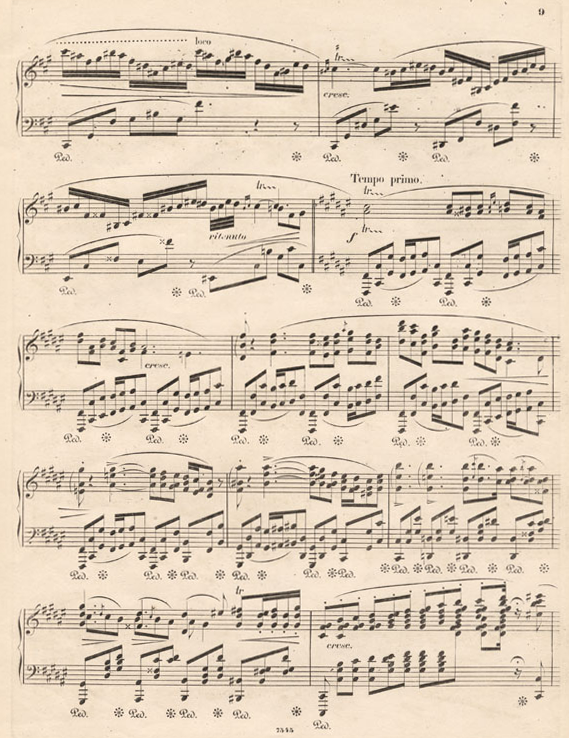
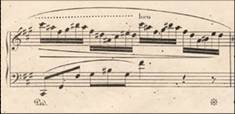
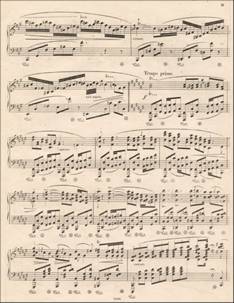
- Chopin, Barcarolle, op. 60, pg. 9
- SharpEye -> MusicXML
- MusicXML -> MEI
|
|
13
|
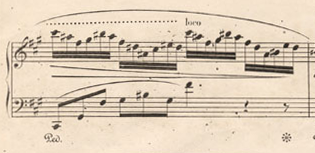
- <measure n="1">
- <staff def="1">
- <layer
def="1">
- <beam>
- <note id="n1"
pname="c" oct="6" dur="16"
stem.dir="down" />
- <note
pname="a" acci="s" oct="5"
dur="16" stem.dir="down" />
- <note
pname="f" oct="5" dur="16"
stem.dir="down" />
- <note
pname="g" oct="5" dur="16"
stem.dir="down" />
- <note
pname="b" acci="s" oct="5"
dur="16" stem.dir="down" />
- <note
pname="a" oct="5" dur="16"
stem.dir="down" />
- </beam>
- <beam>
- <note
pname="f" oct="5" dur="16"
stem.dir="down" />
- <note
pname="d" acci="s" oct="5"
dur="16" stem.dir="down" />
- <note
pname="a" acci="s" oct="4"
dur="16"
stem.dir="down" />
- <note pname="c" oct="5" dur="16"
stem.dir="down" />
- <note pname="e"
acci="s" oct="5" dur="16"
stem.dir="down" />
- <note pname="d"
oct="5" dur="16" stem.dir="down" />
- </beam>
- <beam>
- <note pname="c"
oct="6" dur="16" stem.dir="down" />
- <note pname="a"
acci="s" oct="5" dur="16"
stem.dir="down" />
- <note pname="f"
oct="5" dur="16" stem.dir="down" />
- <note pname="g"
oct="5" dur="16" stem.dir="down" />
- <note pname="b"
acci="s" oct="5" dur="16"
stem.dir="down" />
- <note pname="a"
oct="5" dur="16" stem.dir="down" />
- </beam>
- <!-- last beat omitted -->
- </layer>
- </staff>
- <!-- staff 2 omitted -->
- <hairpin form="dim"
staff="1" tstamp="1" dur="12.5"
place="below" />
- <phrase staff="1"
start="n1" end="d0e843" bulge="+" />
- <pedal staff="2"
tstamp="1" dir="down" />
- <pedal staff="2"
tstamp="12" dir="up" />
- <octave staff="1"
place="above" tstamp="1" dis="8"
dur="6.5" />
- <dir staff="1"
place="above" tstamp="7">loco</dir>
- </measure>
|
|
14
|
- MEI -> Mup (Music Publisher)
- handles layout
- plain text
- notation (PostScript) and MIDI output
- low cost
- macro programming language (extensible)
|
|
15
|
- MEI -> MusicXML -> Notation editor
- currently working on more robust "round trip" (MusicXML ->
MEI -> MusicXML) stylesheets
|
|
16
|
- testing on wider range of material, more review of the DTD
- creation of direct-to-MEI plug-in
- creation of a rudimentary MEI editor
- formulation of an MEI workgroup
|
|
17
|
|
|
18
|
- Perry Roland
- University of Virginia
- pdr4h@virginia.edu
- http://www.lib.virginia.edu/digital/resndev/mei/
|

 Notes
Notes