|
1
|
- Dazhi Jiao, Tamara Lopez, and Jenn Riley
- Indiana University Digital Library Program
- DLF 2006 Spring Forum: Austin, Texas
- April 10-12, 2006
|
|
2
|
- IU Environment
- Case Studies
- EAD IU Finding Aids
- TEI The Chymistry of Isaac Newton
- Analysis
- Xubmit
- Technology overview
- Demonstration
- Conclusions
|
|
3
|
- Digital Library Program provides a central home for library and faculty
digital library activities
- Consulting
- Content creation
- Metadata creation
- Delivery
- Enormous diversity of projects
- Currently undergoing a complete redesign of our digital library software
infrastructure
|
|
4
|
- Encoded by multiple repositories at IU
- Encoding done in <oXygen />
- XML template created and maintained by EAD Working Group
- Completed files delivered to DLP for online delivery
- Currently delivered via DLXS; soon to be delivered via XTF
- Tested RLG’s EAD Report Card for improving encoding workflow
|
|
5
|
- multi-stage, iterative
- transcription
- initial encoding
- XSLT transformation
- editing and proofing
- possible modification of encoding practice(s) and/or XSLT
- repeat steps 3-5 until editors are satisfied.
|
|
6
|
|
|
7
|
|
|
8
|
|
|
9
|
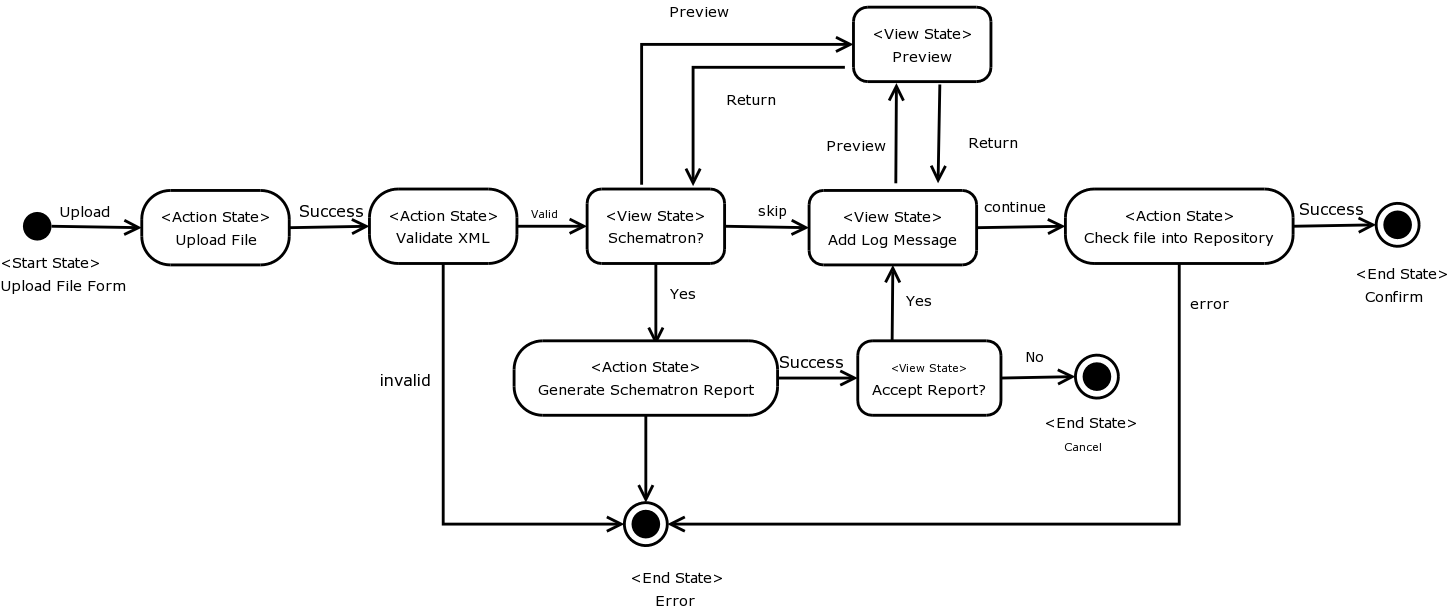
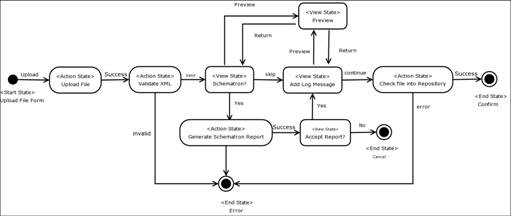
- Submission Flow
- Repository
- JRCS, Platform Independent
- XML Validation / Transformation
- Xerces, Saxon, XML Catalogs
- Web application
|
|
10
|
|
|
11
|
- Pros
- Simple vocabulary
- Allows for robust reporting
- Uses standards: XPATH, XSLT
- Becoming an ISO standard
- Cons
- Verbose
- Maintenance
- No support for variables
- Not an ISO standard yet.
|
|
12
|
|
|
13
|
- Resources
- JRCS: http://www.suigeneris.org/kb/display/jrcs/home
- Saxon: http://www.saxonica.com
- Schematron: http://www.schematron.com/
- Spring Webflow: http://opensource.atlassian.com/confluence/spring/display/WEBFLOW/Home
- Xerces: http://xerces.apache.org/xerces-j/
- XML Catalog: http://www.oasis-open.org/committees/download.php/14809/xml-catalogs.html
- References
- Baecker, R. M, Nastos, D., Posner, I.R. & Mawby, K.L.(1993). The
user-centered iterative design of collaborative writing software. Proceedings of the SIGCHI conference
on Human factors in computing systems.
Amsterdam, The Netherlands, 1993.
pp. 399 - 405
- Dillon, A. (1993) How collaborative is collaborative writing? An
analysis of the production of two technical reports. Published in
M.Sharples (Ed) Computer Supported Collaborative Writing, London:
Springer-Verlag, pp 69-86.
Retrieved April, 2006 from:
http://www.ischool.utexas.edu/~adillon/BookChapters/collaborative%20writing.htm
- Jacinto, M., Librelotto, G. R., Ramalho, J.C.L & Henriques, P.R.
(2002). Constraint specification
languages: comparing XCSL, Schematron and XML-Schemas. XML Europe,
2002. Retrieved April, 2006 from:
http://www.idealliance.org/papers/xmle02/dx_xmle02/papers/03-03-02/03-03-02.pdf
- Jelliffe, R. (2000). Getting
Information into markup: the data model behind the schematron assertion
language. A technical whitepaper
for GeoTempo, Inc. October 19, 2000.
Retrieved April, 2006 from: http://www.sinica.edu.tw/~ricko/schematron.PDF
- Kim, H. & Eklundh, K. (2001). Reviewing Practices in Collaborative
Writing. Computer Supported
Cooperative Work. 10: 247-259, 2001.
- Lee, D. & Chu, W. (2000). Comparative Analysis of Six XML Schema
Languages1. ACM SIGMOD Record 29(3), September 2000.Retrieved April,
2006 from: http://cobase-www.cs.ucla.edu/tech-docs/dongwon/sigmod-record-00.html
|

 Notes
Notes