|
|
|
"What We
Have" (to work with)…
|
|
|
|
Normalized,
tightly structured content. The
structure amounts to buckets. A static
publication of html and pdfs. More
like a book than a “living” website.
|
|
|
|
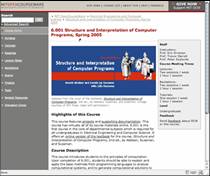
The MIT
OpenCourseWare website has achieved the by no means small feat of gathering
in one place and within one overarching structure the myriad types and kinds
of pedagogical materials in use at a large research university, much of which
was not even digital.
|
|
|
|
In so doing,
they have established what had to be --if they were to succeed-- a highly
normalized single model within which to present every possible MIT course, in
all their variety and distinctiveness.
They brought order where there had been none before, since there never
was reason to establish it.
|
|
|
|
One big plus
coming out of the normalization of courses is the set of "Sections"
that OCW has derived from the range of materials and purposes to which it's
put in MIT classes. This set of some
15 or so heading labels to organize the content according to use or kind or
type is a very useful first cut at organizing a course's content, and is the
first (and only) <organization> we use in the IMS Content Package
manifest.
|
|
Other future
organizations may be used by other future consumers of the content, but this
initial contribution of organization has been critical to a successful user
experience of OCW material widely. You
know what you are getting, from course to course, thanks to these Sections.
|
|
|
|
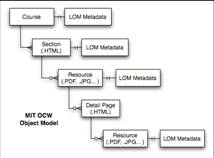
The resulting
"Object Model" lends itself well to a process of mapping onto a
digital archive, as, at the end of the day the rendered publication that is
OCW is a large statically served website.
It is this that we capture into a content package and hence to the
digital archive.
|
|
|
|
The drawbacks to
this process of heavy normalization is that the raw materials, while they
would have been unwieldy to maintain closer to the publication engine, are in
large part left behind in terms of repurposing or disaggregation or even of
editing. This was in practical terms
not possible, especially with the time pressures to publish the essential
first representation of the content, namely the public website. Hence the publication of most material to
the Portable Document Format (PDF) and similar decisions.
|
|
|
|
Subsequent more
varied uses of the content are now being looked at (E.g. archiving;
distribution to other audiences - faculty, translation partners, education
partners, etc.) and some prospects of making available some of the editable
originals (e.g. MS-Office files) is being investigated.
|
|
|
|
NEXT SLIDE SEGUE
|
|
O.K., so … TURN
… What Do We Want To Do With It ?
|