|
1
|
- Historic serials, copyrights, and shared knowledge
- John Mark Ockerbloom
- DLF Spring Forum, Austin
- April 11, 2006
|
|
2
|
- A vast amount of significant serial literature before 1964 is in the
public domain in the US
- Both scholarly and general-interest content
- More complete, and potentially more accessible, view of
mid-20th-century culture and thought than public domain books
- We can determine what is available to digitize
- We have created an inventory of all periodicals renewals 1950-1977 (for
1923-1950 publications; only a tiny fraction renewed)
- This inventory can be the germ of a more comprehensive, cooperatively
built knowledge base
- Leadership opportunities for DLF and its institutions
- We have the big serial collections, the hard-core users, the knowledge
of the literature and of digital library issues
- Low-overhead shared knowledge bases can provided a basis for
coordinating work
|
|
3
|
- “It is time to build… an America where every child can stretch a hand
across a keyboard and reach every book ever written, every painting ever
painted, every symphony ever composed…”
- -- US President Bill Clinton, 1998 State of the Union address
- “Our venture will result in a magnitude of discovery that seems almost
incomprehensible…”
- -- U-Michigan President Mary Sue Coleman, 2006 speech to Association of
American Publishers, on the Google Book Search project
|
|
4
|
- Every book, painting, symphony…
- That is in the public domain
- Or that we can license (actively or passively)
- Or that we can get a special exemption to provide
- fair use
- section 108
- orphan works?
- Snippets of fully indexed text?
|
|
5
|
- Many books before 1923, or 1909, or 1864
- Over 40,000 from Google alone since the fall
- Public domain status determination often very conservative
- Some open access serial runs
- Open access largely seen in nonprofit projects (MOA, newspapers, ILEJ…)
or by journals themselves (smaller-scale)
- Google, Internet Archive, etc. also including some serial volumes along
with the books, not systematically to date
- Larger collections available in limited access (EBSCO, JSTOR…)
- A fascinating assortment of miscellaneous text
- Pamphlets, manuscripts, letters, diaries, blogs, ephemera…
- We won’t focus on that in this talk
|
|
6
|
- Classic or timely wisdom and art
- Would be fresh and valued even if first produced today
- The most widely acclaimed public domain exemplars are already online
- Current, directly applicable knowledge
- Much (though not all) public domain informative literature now outdated
(especially if one only looks pre-1923)
- Entertainment
- Important, but hard to get grants for…
- History and documentation
- Vast majority of interesting
public domain text
- Includes literature, art, essays, science, etc., that are valuable
primarily in a historical context
|
|
7
|
- Newspapers: First reports of events
- Primary sources for history; essential for local history
- Magazines: Literature, essays, debates as they first appear
- And often the only place that they appear
- Lots of short-form work that didn’t make it into books
- Scholarly journals: The record of research
- The hypotheses, the experiments, the data, the debates
- Specialty publications: Insight into communities
- Trade journals, local and special interest groups
|
|
8
|
- Anything copyrighted before 1923
- Anything that’s specifically dedicated
- E.g. fed. gov. docs in US; small amounts of private stuff
- Anything that didn’t “maintain” copyright as was once required:
- Copyrights before 1964 that were not renewed (most weren’t)
- But many of most significant books were renewed
- (note also some may contain separately renewed material)
- Publications before 1989 w/o copyright notice
- (Inadvertent omissions after 1977 sometimes fixable)
- But: Many foreign works were retroactively exempted from maintenance
requirements in 1996
- Key requirement: First foreign publication needs to be more than 30
days before first US publication to get exemption
|
|
9
|
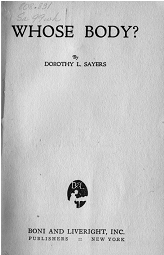
- Popular Lord Peter Wimsey mystery in US public domain since 1951, but
not online until 2005
- Needed to:
- Search renewal records
- Research publication history
- Find a first edition to transcribe
- Meticulously record what we did to clear the book
- Expensive to scale up
- (see work by Denise Troll Covey at CMU)
|
|
10
|
|
|
11
|
|
|
12
|
|
|
13
|
|
|
14
|
- WorldCat lists over 200,000 serials with significant dates between 1923
and 1950
- May undercount based on journals not starting or ending in that range
- May overcount based on duplicate entries for some serials
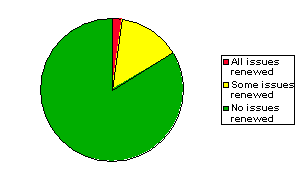
- We found only ~1300 serials that renewed any issue copyrights during
that time
- Most significant serials publishing then did not renew all (or any) of
their issues
- Weak correspondence between extent of renewal and significance to
researchers
|
|
15
|
- No daily newspaper outside New York renewed issues dating before the end
of World War II
- Only a few dailies from 1923-1950 renewed at all
- Earliest renewed issues for some major newspapers:
- New York Herald/Tribune: before 1923
- New York Times (daily): 1928
- Wall Street Journal: 1941
- Christian Science Monitor: 1945
- Chicago Tribune: 1946
- Washington Post: 1951
- Los Angeles Times: 1958
- Boston Globe, Philadelphia Inquirer, many more : No issue renewals
|
|
16
|
- Using JSTOR (as of March 2006) as representative sample of significant
journals:
- 1923-1950 journals in JSTOR: 298
- Number that renewed any issues:
49
- Number renewing first issue in period: 7
|
|
17
|
- Some major magazines renewed from the start (or before 1923)
- E.g. The New Yorker, National Geographic, Sat Eve Post
- Many other majors did not start renewing right away
- E.g. Time, The New Republic, Scientific American
- Many others didn’t renew at all
- Comics, pulp fiction often renewed aggressively
|
|
18
|
|
|
19
|
- Serials may contain separately copyrighted (and separately renewed)
items
- Text: Contributions to periodicals (renewal scans and transcriptions
are available online)
- Inventory of these for serials would be useful too
- Images: Renewal scans not yet online, but there aren’t that many
- Low-hanging fruit for a scanning/transcription project!
- Some possible mitigating factors:
- Section 201(c) gives serial copyright holders presumptive rights to
reprint contributions in original context
- Orphan works provisions might also make it easier to clear
contributions
- Double-check anything you intend to digitize
- Don’t rely on me (or other non-lawyers) for legal advice
- It’s possible we may have missed renewals
|
|
20
|
- Google, Yahoo, Microsoft?
- Serial content being ingested along with monograph content
- Thus far not being treated specially or systematically
- Commercial aggregators?
- Already broad coverage, but still limited; limited access; no inherent
monopoly on public domain content
- Let central consortia do it?
- JSTOR et al can’t do everything; and limited access may inhibit reuse,
repurposing, remixing
- Libraries do it ourselves?
- We have the content, constituency, mission, know-how
- Scanner tech, storage, and sharing all getting cheaper
|
|
21
|
- Renewal scans were contributed by many, inventory created by individual
- Just using flat files served by Apache
- Thanks: Greg Weeks, Juliet Sutherland & Distributed Proofreaders,
CMU, Penn, several public libraries
- Many may need to do copyright research
- Searchable databases useful for quick lookups
- Registries useful for pooling information
- Rights clearance info could also be machine-readable
- See e.g. rights expression work by Karen Coyle, CDL
- Needs to avoid inhibiting expression, contributors
|
|
22
|
- Usability: Should be easy for humans and programs to comprehend as
needed
- Main machine-processing requirement: Lookup
- Inclusiveness: Make it easy for researchers to contribute any relevant
information
- What work (journal, issues…) is being referred to?
- What is asserted about its copyright?
- What are the facts that support this assertion?
- Who is making the assertion? (And perhaps: when?)
- Reliability: Support degrees of certainty and authority, audit (history)
trail
|
|
23
|
- Stick with individually curated flat files?
- Certainly easy to store, trade; hard to scale
- Wiki base with structured data and review?
- We built one not long ago: Fred (format registry demonstration that was
prototype for GDFR)
- http://tom.library.upenn.edu/fred/ for reference
- Add-on to existing catalog/registry?
- E.g. Registry of Digital Masters on OCLC
- Should extended scope be considered?
- Journals: Info on digitizations as well as copyright?
- Copyrights: info on non-journal copyrights as well?
- Who will use and support it, and what do they need?
|
|
24
|
- We have many valuable, relatively recent serials that are fair game to
digitize and share
- An opportunity largely untapped to date (at least post-1922)
- We now have, or can get, the information we need to determine their
status and share them digitally
- DLF and its member institutions are particularly suited to leading in
this area
- Due to our collections, the research we support, and our expertise
coordination
- It would be useful, and feasible, to coordinate our efforts and our
information gathering
- E.g. by contributing to appropriate information registries
- We should begin discussions on how best to move forward
|
|
25
|
- Initial inventory and copyright renewal records at
- http://onlinebooks.library.upenn.edu/cce/
- You can contact me at
- What information could you use?
What could you contribute?
- Let’s start the conversation
|

 Notes
Notes