|
1
|
- Eva Müller
(eva.muller@ub.uu.se)
- Uppsala University Library
- Sweden
|
|
2
|
- Project started 2000 at Uppsala University, Sweden
- Objectives of the DiVA Project:
- Develop technical solutions & workflows supporting full text
publishing, storage and dissemination of university research
- Explore ways to ensure future access, ability to render and understand
digital objects in the archive
- 2006 – cooperation within 17 universities in Sweden(15), Denmark (1) and
Norway (1)
- Cooperation with the National Library from the very beginning
|
|
3
|
- How can we ensure access to digital objects we produce locally?
- A stable point of reference
(persistent identifier)
- Storage in several locations (cooperation with trusted organizations)
- Why to implement IDs and ID resolution?
- Stable point of reference
- Helping to solve the ” 404 not found –message” problem
- Making possible to move services and objects without risk of “broken
links”
|
|
4
|
- For the DiVA project we need an ID scheme which allows us
- Easy, reliable and cost-effective maintenance and administration
- Potential to connect additional access/preservation copies to the same
ID
- Potential to be integrated into automated and low-cost workflows
- Non-proprietary solution
|
|
5
|
- Cooperation with a trusted, public and non-profit organization
(sustainability – lower risk)
- Management of a resolution service, other metadata services and an
archival copy within the same framework (self-interest – lower risk)
- Possibility to use the same PID for different manifestations of the
same content
- Sustainability – beyond the http protocol
|
|
6
|
- Primary decisions:
- Decision to cooperate with the National Library of Sweden
(sustainability, self-interest)
- Decision to fit all needs into an automated workflow (low cost,
sustainability)
- Secondary decisions:
- Decision to use URN:NBN as a primary persistent identifier
- Decision to develop a resolution service
|
|
7
|
|
|
8
|
|
|
9
|
- Creating a simple solution that works is better than waiting for a
perfect solution
- It makes it possible to introduce the concept of an actionable
identifier to users and to demonstrate its power in a practical way
- (If component based system development is used ) When new demands, more
resources or new technologies appear, some of the components – or the
entire application – can be replaced by enhanced ones
|
|
10
|
- Core functionality
- Provides resolution by identifying valid URL(s) for resources which have
been assigned an identifier within the URN:NBN namespace
- Provides indirect resolution for other id-schemas which have been registered
- http://urn.kb.se/resolve?doi=10.1016/S0021-9797(03)00401-6
- http://urn.kb.se/resolve?hdl=10.1045/may2001-kahn
- Additional functionality
- Provides details about the authority which has been assigned a
sub-namespace within the national URN:NBN domain
- Can store standard metadata for each object together with its assigned
ID
|
|
11
|
|
|
12
|
- The quality of the service relys on the fact that relationships between the ID and the
associated location(s) of the object (in Internet context, URL) are
up-to-date
- Relevant questions are:
- How to maintain these relationships (mappings)?
- How to make updating of mappings between location and identifier low
cost and reliable?
- How to guarantee such a service in the long term?
- (In Internet based digital library environment PID –> URL,
- in physical library environment
PID –> shelf mark)
|
|
13
|
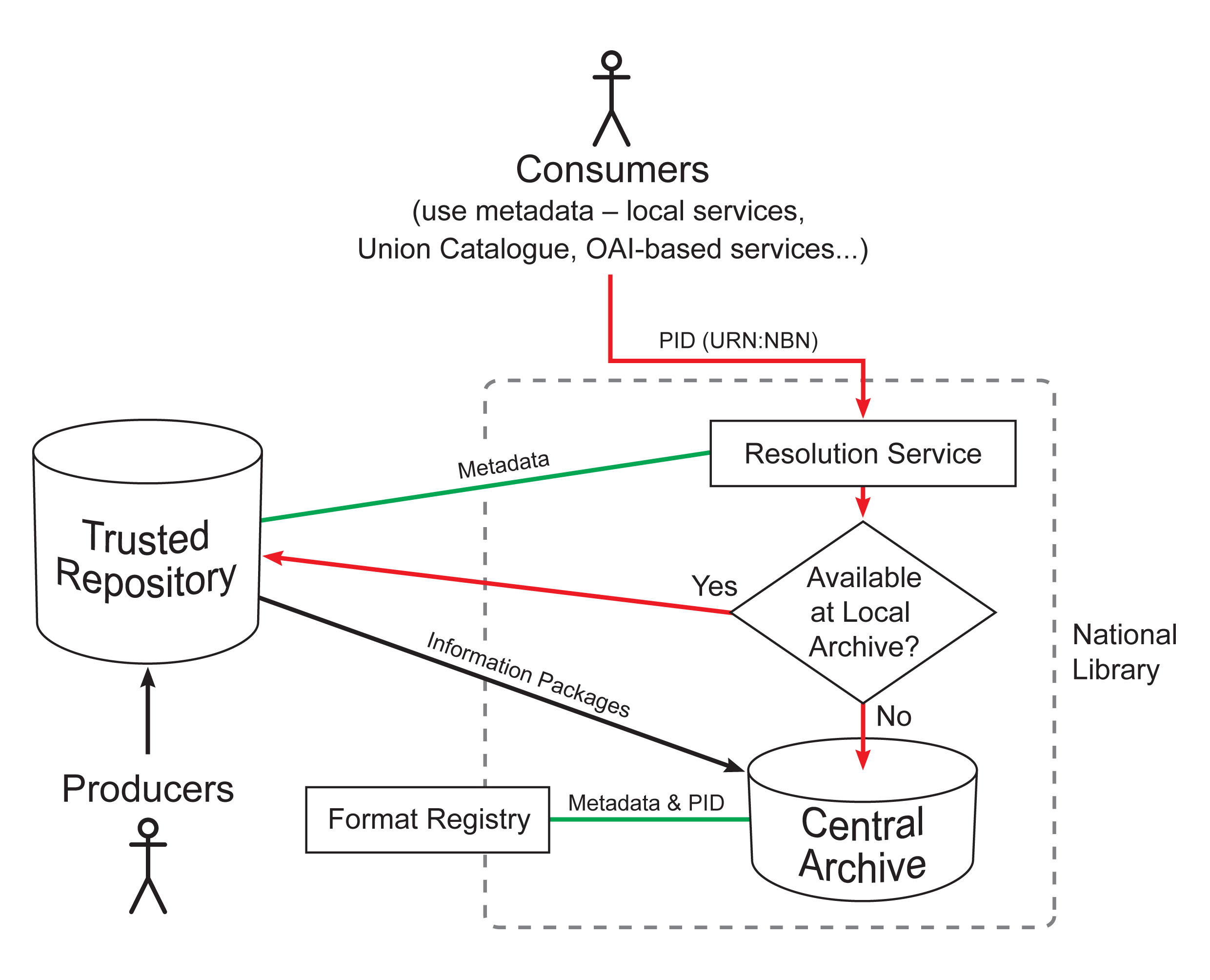
- Integration in a publishing/depositing workflow
- IDs are assigned automatically
- Mappings are made available to the resolution service for updating
- urn:nbn:se:uu:ub:epc-schema:rs-location-mapping
- Updating of the central service
- The RS application harvests relevant data to update the mappings &
possibly metadata
- The RS application can merge information about multiple locations
referenced by the same ID
|
|
14
|
- Java, XML, XML Schema, JSP, HTML
- Open Source
- In operation at NL in Sweden, in Denmark installed at Århus
Staatsbibliotek, in Finland installed at the Helsinki Technical
University
- Originally planned to build a network of services based at NL’s in
Scandinavia
- Not implemented (organizations and political level issues)
|
|
15
|
- Lack of expertise or staff to maintain the service at national libraries
(Finland, Iceland and Sweden at the beginning)
- Lack of interest for “outside” solutions from the NL (Denmark, Norway)
- Difficulty cooperating effectively with NL outside of Scandinavia
- Lack of positive interest and desire to understand from projects running
other solutions (defensive position about our choice of URN:NBN)
- Socially based problems
- Not really technical ones
|
|
16
|
- Some constraints in the current approach
- The NBN should be assigned only to resources which the NL is interested
in delivering and archiving
- There is need to use an ID schema which supports all kind of objects
- Some strengths
- The DiVA systems supports various identifier schemes through an
identifier agnostic element
|
|
17
|
- The methods and tools developed for resolution of NBN supports other ID
schemes
- by indirect resolution (pointing out to other services)
- by direct resolution under condition the mappings can be harvested by
RS
- The architecture is designed to be distributed
- ? Scalability
- ? Willingness of other resolution service providers to exchange data
|

 Notes
Notes