|
1
|
- Fynnette Eaton
- Change Management Officer
- Digital Library Federation Spring Forum
|
|
2
|
- The National Archives & Electronic Records
- Challenges of Electronic Records
- Development of ERA System
- Design and Deployment Goals
- Current Status of ERA Program
- ERA’s Virtual Lab and Partnerships
- Change Management in ERA
|
|
3
|
- The National Archives and Records Administration (NARA) … is a public
trust on which our democracy depends.
- It enables people to inspect for themselves the record of what
government has done.
- It enables officials and agencies to review their actions and helps
citizens hold them accountable.
- It ensures continuing access to essential evidence that documents:
- the rights of American citizens
- the actions of Federal officials
- the national experience”
|
|
4
|
- Made or received in the course of business or under law
- Kept because it
- Provides evidence of organization, functions, policies, decisions,
procedures, operations, or other activities of their creators, or
- Contains valuable information
- NARA holds many records and record types
- Reels of motion pictures
- Maps, charts, and architectural drawings
- Sound and video recordings
- Aerial photographs
- Still pictures and posters
- Computer data sets
|
|
5
|
- Scope – The Entire Federal Government
- Variety – Different Types of Records
- Complexity – Records in Different Formats
- Volume – Enormous Amounts of Records
- Obsolescence – Constantly Changing Technology
|
|
6
|
- NARA has more than 30 years of
experience with electronic records
- Mostly simple files
- Comma delimited
- ASCII
- Flat fixed length
- Current systems do not meet the need
- A new and comprehensive approach to records storage and preservation is
required
|
|
7
|
|
|
8
|
- The nature of electronic records differs from traditional records
- Traditional (hard copy) records
- Inscribed on their media
- Preservation is performed on the object
- Electronic records
- Represented as binary values that must be translated to a different
form in order to communicate the record
- It is the result of this reproduction, not the stored bits, that is the
electronic record
- It is this ability to reproduce the record that must be preserved
- The preserved re-creation/translation must be authentic
|
|
9
|
- Authenticity … the property of a record that is what it purports to be
and has not been corrupted
- Traditional Records
- Preserve and maintain the medium (content)
- Document and maintain a chain of custody
- Maintain the context of the records to other records
- For complex electronic records (databases, web sites, geographic
information systems, virtual reality models), we need to preserve the
essential properties of the record
- Content
- Context
- Structure
- Behavior
|
|
10
|
- Electronic records are stored on media, which of course needs to be monitored and
maintained, but
- Electronic records relying for access on technology that arises and
evolves rapidly are subject to obsolescence:
- Computing platforms
- Communication infrastructures interconnecting platforms
- Data recording formats
- Software used to reproduce the records
|
|
11
|
- 1998-2000 Research
- The Archivist established the ERA Program
- Research partners are formed to find solutions to electronic
- records challenges
- 2001-2003 Program Development
- Contractor Team brought in to assist with program management
- Key Integrated Product Teams (IPTs) Chartered
- Key Program documents completed
- Staffing of the Project Management Office (PMO)
- 2004-2007 Designing and building ERA
|
|
12
|
- Solicitation strives to define the electronic records challenge without
prescribing implementation or techniques that address the issues
- Very little design specifics within the procurement documents
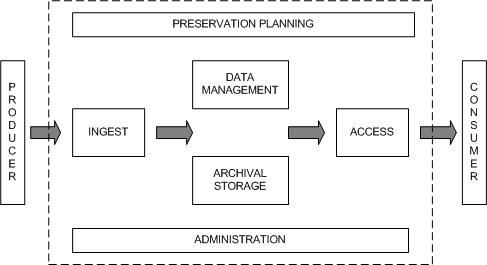
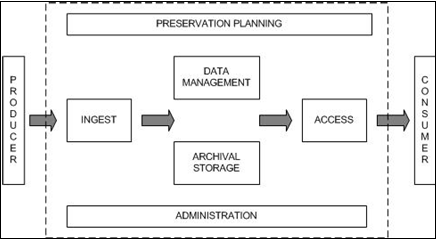
- OAIS Reference Model and some Department of Defense and National
Institute of Standards and Technology standards are included
- Goal is to challenge industry to propose innovative solutions to the
electronic records challenge
- Preservation
- Authenticity
- Support for variety of Record Types and Data Types
|
|
13
|
|
|
14
|
|
|
15
|
- NARA must own and control at least one set of all holdings of electronic
records entrusted to it
- The ERA system is one of NARA’s contributions to the Federal Enterprise
Architecture (FEA)
- NARA must produce a highly reliable system design
- NARA must take a long term view for the system’s operation and its
required scalability, reliability and cost effective operations
- Support outsourcing of potential processing, hosting services, and
value added processing
- While ensuring NARA’s stewardship of the records entrusted to it
|
|
16
|
- Insure system integrity
- Establish security and accommodation of restoration services to protect
records from alteration, loss or lack of access capability over time
- Manage the evolutionary nature of the ERA system, particularly
- Changes to Persistent Preservation approaches
- Upgrades to the general infrastructure and support technologies used in
the system
- Handle expected ERA Record Holdings
|
|
17
|
|
|
18
|
- The Virtual Archives Laboratory (VAL)
- A Joint Partnership
- NARA
- San Diego Supercomputer Center (SDSC)
- University of Maryland Institute for Advanced Computer Studies (UMIACS)
- Georgia Tech Research Institute
- National Center for Supercomputing Applications
- National Institute of Standards & Technology
- Federated Persistent Archives
|
|
19
|
- Change Management will…
- Enable ERA to successfully achieve its goals
- Create awareness among ERA stakeholders
- Facilitate alignment between processes, people and technology
- Allow the assimilation of stakeholders to the changes ERA brings
|
|
20
|
|

 Notes
Notes