|
The
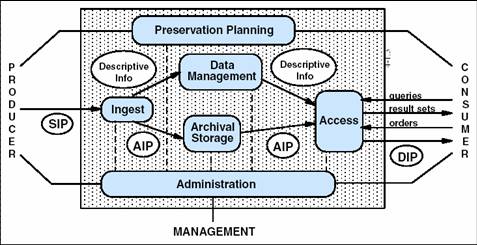
famous “OAIS Diagram” shows us a stylized high-level view of an archive.
[Bearing in mind the fundamental fact that “the map is not the terrain, “] we
can differentiate five kinds of features: the blue “functional entity
groups”, the “information packages” in the white ovals, three external
generalized Actors, some solid and dotted lines suggesting relationships
among the blue entity groups and the actors, and some arrows implying a
directed data flow. If this diagram has never really made sense to you,
you’re not alone. We have to look deeper to understand how this model
describes all archives.
|
|
Over the
past few years we have become familiar with the terms "Ingest",
"Access", "Archival Storage", "Preservation
planning", Administration" and "Data Management" as the
components of an OAIS archive. And we've learned to talk about metadata in
terms of the OAIS Information Package: the SIP, AIP, and DIP. If
understanding these terms were all there is to creating an archive, we would
all be practicing good long-term preservation of our digital assets. Of
course, there is more to the OAIS reference model than these basic
concepts, and from the beginning of the EATMOT project we knew we needed a
deeper understanding of them to build a working digital archive.
|