Find it at Cornell usage
| And what about
Find it at Cornell? We are very
interested in how many users are clicking on the Find it at Cornell link from
a find articles object record, and further, how many are then clicking on the
full text when that option is available for a given article. Since reference linking is a service that
users highly value and expect more and more, we anticipated that full text
access would be high. |
|
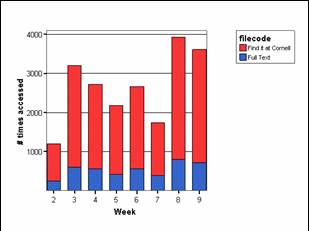
| The chart on the
left shows you the breakdown between simply clicking on the Find it at
Cornell screen and clicking on the full text link for an article. The red represents how many times users
clicked on Find it at Cornell, and the blue represents how many times they
went to the full text. Given the
assumption that users want to go to the full text and would click on a link
if it were present, the numbers you see here surprised us. |
|
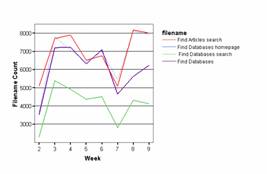
| I added the
chart on the right for a point of comparison – take a look at the top line,
which represents the number of times Find Articles was accessed, week by
week. For example, if we look at week
2 for this chart and compare it to week 2 of the chart on the left, we can
surmise that out of about 5,000 sessions where users searched Find Articles,
the Find it at Cornell screen was accessed about 1,200 times. From there, users clicked on roughly 250
full text articles. Again, it appears
users are connecting to full text via Find Articles and Find it at
Cornell a surprisingly small
percentage of the time. At this point,
we have only about 35 remote repository connections in Find Articles, whereas
Find Databases connects to over 1,000 resources. Although it is true that not all of the 35
remote repository connections in Find Articles link to full text articles, it
is also true that reference linking should allow for a much higher rate of
full text access. Currently, the
number of electronic journals in our “knowledge base” in LinkFinder Plus
covers about 90% of our total Cornell subscriptions. |
|
| These results
leave us with some important questions: |
|
| Are users
selecting and searching more non-full-text rather than resources through Find
Articles? If they are searching full
text resources, are they having difficulty recognizing how to connect to the
full text? Currently, we have the full
text link showing up at the bottom of the Find it at Cornell page, below our
Catalog search options, as is the default display setting in LinkFinder
Plus. We are in the process of moving
the link up above the catalog search options so it will be interesting to see
if that display order increases the number of connections to full text. Beyond that, we need to do some user
observation to determine how users are navigating Find it At Cornell and
whether or not they are missing the links. |
|