Databases Searched via Find
Articles or Find Databases
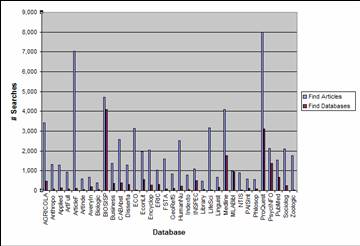
| You might wonder
how users are connecting to databases now that we have two points of access –
Find Articles and Find Databases….Here is a look at the month of
October. Connections through Find
Articles are in the bars to the left, in light blue, and connections to Find
Databases are in the bars to the right, in purple. |
|
| At first glance,
it looks like many more users are searching databases through Find
Articles. However, there is a big
caveat here: whenever a user clicks on
a database from Find Databases and then connects, we have no record of how
many times he or she then runs searches in that database. That is information that only the vendor
has at the present time. In contrast,
since we have access to the data for how many times a user connects to a
remote repository in Find Articles, via our ENCompass tables, we can
determine how many actual searches were run per database. As a result, the number of searches by
database in Find Databases should be much higher than what you see here – we
are only able to represent the first search each user runs. |
|
| Therefore, what
you are looking at is not an accurate comparison. For example, after a user connects to Find
Databases, we do not know how many searches were run. In order to run a true comparison, we would
need to obtain vendor information on individual number of searches for
Cornell users, by database. |
|
| Because the Find
Databases numbers you see are artificially low, we know that users are
accessing certain databases (ProQuest and BIOSIS, for example) through the
native interface more often than through the Find Articles page. (If we were looking at a one-to-one search
comparison, the purple bars would be much higher.) In contrast, take a look at ArticleFirst
and Zoological Abstracts. A relatively
small number of users searched those through the native interface, while a
significant number of those users searched them through Find Articles. |
|