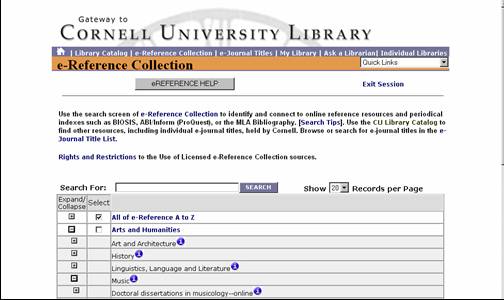
October prototype: search/browse
resources
| Here is
what our main screen looked like for the October 2002 user testing
sessions. It still replicated the
“Browse/Search Resource” screen of the ENCompass 2.0 interface quite closely,
though we did choose to remove the direct searching connections and integrate
article level searching into the interface later. From the page you see, users could only
search and browse metadata about resources, as was the case with the
e-Reference interface. |
|
| The 2.0 design
included a shaded table format with expandable/collapsible categories and
checkboxes and presumed that the user knew to type a query term in the search
box and then select one or more categories and/or specific resources below it
to run a search. We found that
users were confused by this design, for several reasons. |
|
| Browsing
and searching capabilities were presented in a way that was not
intuitive. It took users some time to
figure out how to navigate the series of checkboxes beneath the search
box. This was compounded by the
expanding/collapsing checkbox categories design; expanding a category meant
reloading the screen with more subcategories showing and more shaded rows in
the table to scroll through. Users
were disoriented as they clicked deeper and deeper into the same screen. |
|
| Further,
some users did not understand that they could select and search for more than
one resource at a time. While
cross-collection searching was a familiar concept to our users in other
contexts, it was new to the e-Reference collection and required clearer
presentation. |
|
| As had
been the case in the past, users still attempted to perform article level
searching, despite the explanatory text at the top of the page. The e-Reference interface had included
similar text, but clearly, many users were not reading it. |
|
| Finally,
the name “e-Reference” appeared to hold less meaning than we anticipated for
most of our users. In this early
prototype, you can see that we retained the “e-Reference collection” name at
the top. We wanted to preserve the
identity of this heavily used system and had assumed that keeping the same
name was important to our users. While
it is certainly true that experienced users identified with the name and that
many librarians favored keeping it, our sample indicated that the name was
not particularly meaningful to new users.
And, as we looked at adding the article level searching functionality,
the name became problematic. |